
The Life and Times of Swami Vedanta Desika 🌟
Based on historical records, Swami Vedanta Desika represents a prestigious lineage connecting back to the direct disciples of Sri Ramanuja on both sides. His father belonged to the Vishwamitra Gotra, and his mother belonged to the Atreya Gotra (the lineage of the Kidambis).
🌳 Sacred Lineage & Family Tree
The following heritage traces the connection between the great masters of the tradition:
Paternal Side (Vishwamitra Gotra)
- Somayaji: A direct disciple of Ramanuja and one of the 74 Simhasanadhipathis (leaders) appointed by him.
- Pundarikaksha: The son of Somayaji and a great Yajwa (sacrificer).
- Anantha Suri: The father of Swami Vedanta Desika.
Maternal Side (Atreya Gotra)
- Kidambi Achan: Personally cooked for and served Ramanuja in the Madapalli (kitchen).
- Kidambi Ramanuja Pillan
- Kidambi Padmanabhachariar
- Appillar: Desika’s Uncle and Guru. He arranged the marriage of his sister, Totaramma, to Anantha Suri.
- Totaramma: The mother of Swami Vedanta Desika.
✨ Divine Birth and Original Name
- Original Name: His parents named him Venkatanathan.
- Birth: He was born in 1268 CE (Vibhava year) in the month of Purattasi (Bhadrapada) under the Sravana star. 🌠
- Place: He was born in Thuppul, a place known for pure grass (darbha), near Kanchipuram.
- Divine Origin (The Bell): Before his birth, his parents visited the Tirumala temple. In a dream, Totaramma saw herself swallowing the Ghanta (bell) of the Lord. The next day, the temple bell was found missing. It is believed that Desika is the Ghantavatara (incarnation of the Bell) of Lord Venkateswara. 🔔
🦁 The Titles of a Genius
While his birth name was Venkatanathan, his immense knowledge earned him universal acclaim:
- Vedanta Desika: This title means "The Teacher of Vedanta." It was conferred upon him by Lord Ranganatha and Goddess Ranganayaki at Srirangam. He was also honored as Vedantacharya and Kavitarkika Simham (The Lion among poets and logicians).
- The Blessing of Nadadur Ammal: When Venkatanathan was only five years old, his uncle Appillar took him to the Varadaraja Perumal temple. The aged scholar Nadadur Ammal was lecturing but paused, attracted by the boy's radiance. When the scholar forgot where he had stopped, the child instantly reminded him of the exact line from the Vishnu Purana: "Para Paranam Paramaha..." 📚
- Nadadur Ammal hailed him as an Eka Sandha Grahi (one who grasps everything heard once) and predicted he would establish the Vedanta.
- Sarvatantra Svatantra: Meaning "Master of all arts and crafts." This reflected his versatility as a philosopher, poet, logician, and craftsman (he even sculpted an idol and constructed a well at Thiruvahindrapuram). 🛠️
📜 Table of Contents: Major Life Phases
- Divine Birth and Lineage: The Atreya and Vishwamitra heritage and the dream of the Tirumala Bell.
- Childhood Blessings: Tutelage under Kidambi Appillar and the famous "Vittathu Enge?" (Where did you stop?) incident with Nadadur Ammal.
- Thiruvahindrapuram Phase: Migration due to religious unrest and the Hayagriva Upasana on Oushadagiri hill, where Lord Hayagriva and Garuda appeared to him.
- Literary Masterpieces: Compositions like Sankalpa Suryodayam (a philosophical play), Hamsa Sandesam (poetry), and Yadavabhyudayam (an epic on Krishna).
- Miracles and Hymns: Subduing snake charmers, raining gold coins via the Sri Stuti, and singing the Goda Stuti for Andal. 🪙
- The Challenge at Srirangam: Composing 1,000 verses of the Paduka Sahasram in just three hours.
- Preservation of Knowledge: Protecting the Sruta Prakashika during the sack of Srirangam and the eventual restoration of the temple.
🎨 Poetic Imagery: Chitra Paddhati
In the 30th chapter of the Paduka Sahasram, known as the Chitra Paddhati, Swami Desika integrated visual geometry with literature:
- The Wheel Pattern (Shadara Chakra Bandham): Letters are arranged in a wheel. Reading the spokes clockwise reveals the signature: "Vedanta Desika Krita Paduka Sahasram." 🎡
- The Drum Pattern (Mridanga Bandham): Syllables form the visual shape of a Mridanga (drum). 🥁
- Ardha Bhramarakam: A magic square where the verse reads the same horizontally and vertically.
- Anuloma Pratiloma: Palindromic verses that yield meanings when read both forward and backward.
🔢 Mathematical Genius: The Knight's Tour
Based on historical sources, the Paduka Sahasram (a collection of 1,008 verses on the sandals of Lord Ranganatha) composed by Swami Vedanta Desika contains sophisticated mathematical patterns and poetic complexities that predate similar discoveries in Western mathematics by centuries.
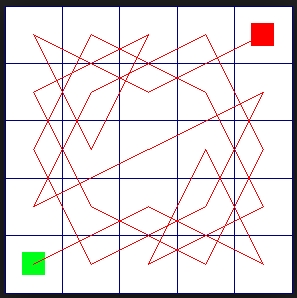
1. The Knight's Tour Problem (Chaturanga Turanga Bandham)
The most prominent mathematical feat in the Paduka Sahasram is the solution to the Knight's Tour problem.
The Problem: In chess, the Knight (horse) moves in an "L" shape (two squares in one direction and one perpendicular). The "Knight's Tour" requires the knight to move across the chessboard, touching every square exactly once without repeating a position. ♟️
Western Timeline: This was identified as a problem by Euler in the 17th century, and a formula for it was provided by a German mathematician in the 19th century.
Desika's Solution (13th Century): Centuries earlier, Swami Desika embedded this solution in the Paduka Sahasram. By arranging the syllables of two specific verses in a grid, one can follow the movements of a Knight on a chessboard to derive the next verse.
- The Method: If you write the 32 syllables of a verse in a grid and move from the first letter using the Knight's move (e.g., two places forward and one left) to the next position, and continue this pattern, a new meaningful verse is formed from those letters.
2. The Significance of the Number 32
The number 32 is central to these mathematical compositions (representing the 32 syllables in a verse and the 32 squares of one color on a 64-square chessboard). This unique two-digit number satisfies two specific mathematical properties:
- Property 1: $x^y + y^x$ (e.g., $2^4 + 4^2 = 16 + 16 = 32$)
- Property 2: $x^x + y^y + z^z$ (e.g., $1^1 + 2^2 + 3^3 = 1 + 4 + 27 = 32$)
3. Context of the Composition
The genius of these mathematical embeddings is amplified by the extraordinary circumstances of their composition:
- Speed: Swami Desika composed the entire Paduka Sahasram (1,008 verses) in just three hours (one yama) during the night.
- The Challenge: The work was created in response to a challenge from a rival poet who had composed 300 verses on the Lord's feet. Desika chose to sing the praises of the Lord's sandals (Paduka) instead, considering himself unworthy to sing of the feet directly, and produced over three times the volume of verses in a fraction of the time, while incorporating these complex mathematical structures. 🏆
🛡️ The Karnataka Phase & Preservation
The invasion of Srirangam by Malik Kafur and Ulugh Khan forced Desika to flee to protect the sacred lineage.
1. The Arbitration at Mulbagal He acted as the judge for a 15-day debate between Vidyaranya (Advaita) and Akshobhya Tirtha (Dvaita). Unable to travel, he reviewed written arguments and declared Akshobhya Tirtha the winner with the verse "Asina Tattvamasina...". This verdict is still inscribed on a pillar in Mulbagal. 🏛️
2. Preservation at Satyagalam
- Saving Scriptures: He hid among corpses to escape the slaughter at Srirangam, carrying the Sruta Prakashika and the sons of his Guru to safety.
- Literary Output: In exile, he wrote Adhikarana Saravali, Tattva Mukta Kalapa, and Satadushani.
3. Restoration of Srirangam Desika was the catalyst for the liberation of the temple. He contacted Koppanna, a Vijayanagara general, urging him to drive out the invaders. When the temple was restored, Desika praised the general with the verse "Yasho Darpanaha Koppanaryaha". ⚔️
4. Enduring Friendships Despite philosophical differences, he maintained a deep mutual respect with Vidyaranya, who had been his fellow student in Kanchipuram. 🤝
References:
📝 Acknowledgment & Disclaimer
These articles are based on discourses by Sri Dushyanth Sridhar, who renders discourses in English & Tamil on Rāmāyana, Mahābhārata, Bhāgavata, Vishnu Purāna, Bhagavad Gitā, Vishnu Sahasranāma, and Divya Prabanda in the upanyāsam, pravachanam, or kālakshepam style. Visit [https://desikadaya.org](https://desikadaya.org) for more information. These notes are presented solely for educational purposes to help viewers download and benefit from these teachings. Any incorrect interpretations or inaccuracies are mine and unintentional—please forgive me. For any feedback, please send an email.